Culture Transformation
The Foundation
Where this sits: the foundation. Everything the other four services design is built on top of this.
Culture is an organisation's constraint-logic — the foundation the whole organisation is built on. It quietly determines what becomes adaptive, what becomes costly, and what becomes impossible.
And because culture is the foundation, not the behaviour on display, you can't coach your way to a new one. Coaching changes how people act on a given day; it never reaches the ground they're standing on.
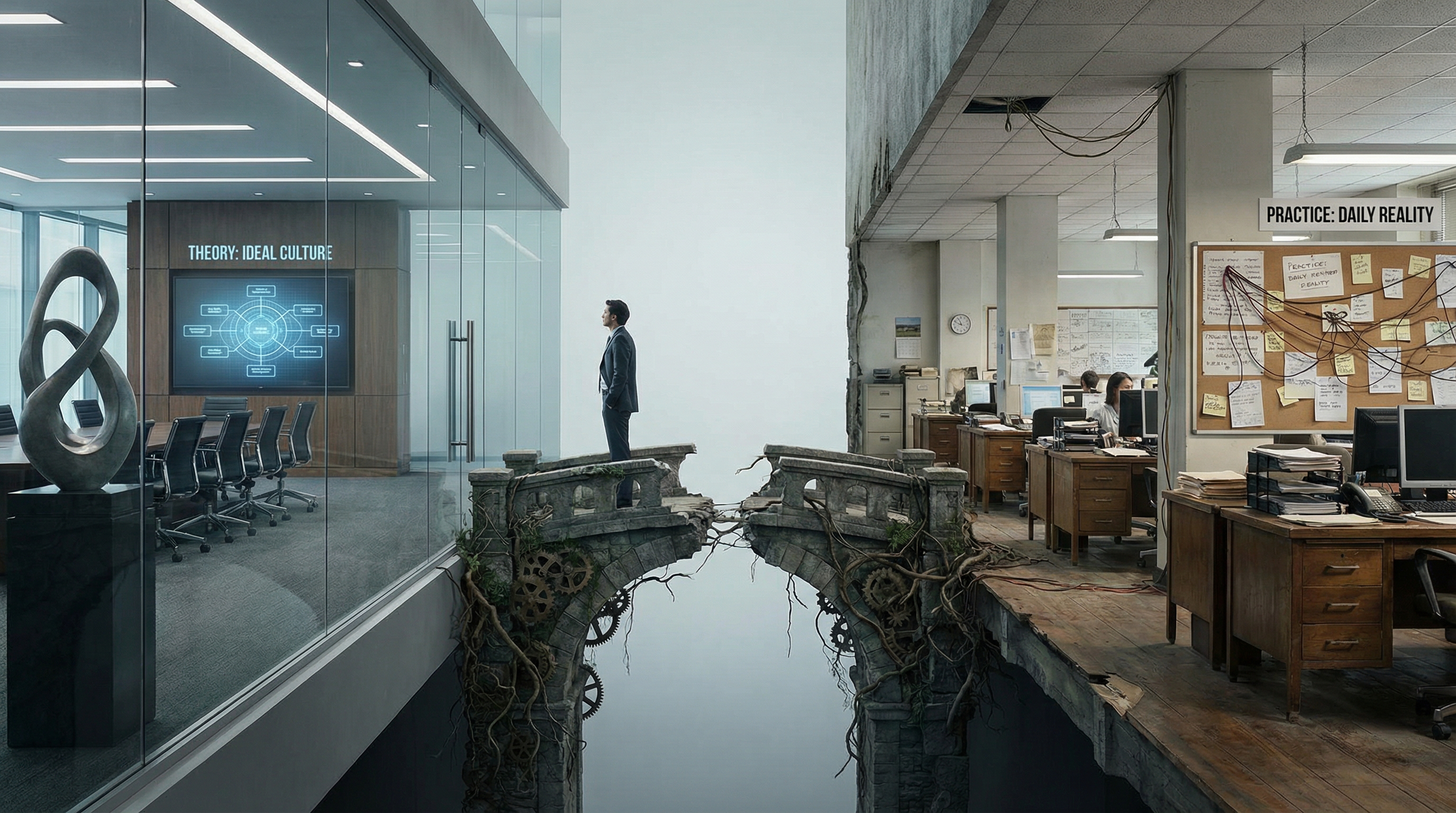
In organisations the problem is rarely a missing foundation, it's that the architecture sitting on top of it was built to a different blueprint. Leadership names one culture; the incentives, decision rights, and reporting lines quietly enforce another. The structure ends up pulling against its own foundation, and that strain surfaces as everything people call a "culture problem."
Culture transformation is the work of settling that foundation and rebuilding the architecture so it finally rests true on it.
What it Solves
The usual labels, values misalignment, behavioural drift, culture fatigue, change resistance, describe symptoms, not causes. Beneath each is the same fault line: the gap between the culture leadership names and the architecture it has actually built on top of it.
That gap is what makes dysfunction rational:
Values that don't match lived experience.
The architecture rewards something else entirely: speed over quality, politics over clarity, compliance over candour.
Behaviour that persists despite training.
Training can't override the logic of the system people work inside. They act in the ways that help them survive it.
Cultures of internal competition, avoidance, or compliance.
These aren't character flaws; they're rational responses to the incentives, decision rights, and consequences people actually face.
Culture initiatives that never stick.
They collapse the moment they contradict the structure beneath them, because that structure was never touched.
This isn't a communications problem. It's a design problem.
The Three Artefacts
This is what culture transformation uniquely works on. Three artefacts define the foundation. Get them right and everything built above has something solid to stand on; get them wrong and the flaw is inherited all the way up.
Direction - where the organisation needs to go.
The strategic trajectory, ambition, and constraints that set its course.
When Direction is unclear, the foundation shifts and culture fragments.
Hallmarks - what the organisation genuinely excels at.
The competence signature that gives the organization authenticity and advantage.
If Hallmarks are vague, culture turns to theatre.
Shared Values - the decision constraints that protect the Hallmarks.
The lived, shared values that govern how trade-offs are made, how conflict is resolved, and how standards hold.
When Shared Values are decorative, culture buckles under pressure.
Our Approach
We don't refresh values, run workshops, or teach behaviours. Those interventions assume culture is psychological; something you can talk your way into. We work at the two levels where culture is actually settled: the foundation itself, and the architecture built on it.
The foundation:
Direction: clarifying the strategic trajectory and its constraintsHallmarks: defining the competence the organisation is built to excel at
Shared Values: turning those values into real decision constraints
The architecture that must rest on it:
Signals: What leadership pays attention to.
Incentives: What the system rewards.
Decision rights: Who decides, on what basis, and with what consequences.
Spans and layers: The logic that governs managerial capacity.
Consequence pathways: How standards are actually enforced.
Competency architecture: What "good" concretely means.
Remuneration architecture: The organisation's most honest signal.
Culture holds when the architecture is built true to the foundation, so that the right behaviour is also the rational one.
When the two contradict each other, the architecture wins and the values become decoration.
That is the real bridge between what a culture claims to be and what it does under pressure: it becomes real only once the structure stops fighting the ground it stands on.
Outcomes
Engagement scores, values-adoption rates, sentiment trackers, those are theatre metrics.
We're after outcomes you can build on:
Behaviour that lines up with strategy,
because the structure now rests on the foundation instead of contradicting it.
Less defensiveness and internal friction.
When the architecture is coherent, people stop protecting themselves and start contributing.
A culture that is load-bearing, not decorative.
It is the ground the organisation stands on, not the wallpaper.
An environment where competence, candour, and clarity get rewarded
rather than quietly penalised.
Direction, Hallmarks, and Shared Values aligned and operational,
so the culture is something the organisation is built on and not something it aspires to.