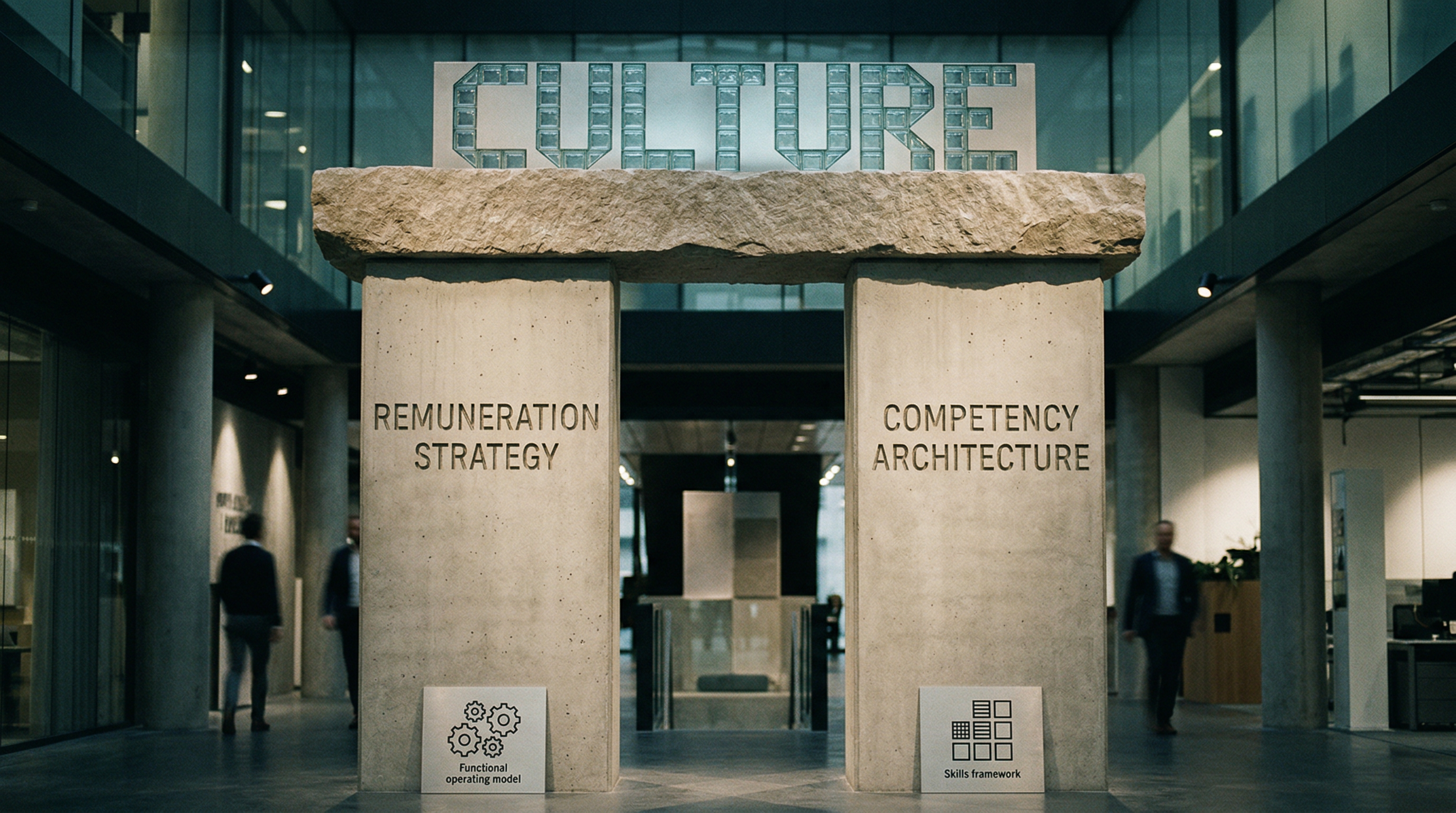
Remuneration Strategy
The most honest signal
Where this sits: one of the two load-bearing pillars (with competency architecture) that carry the cultural foundation into daily reality.
Remuneration is the most honest statement an organisation makes about what it values and what it's willing to tolerate. Every value an organisation claims is tested against its pay structure, and where the two disagree, pay is believed. It isn't a reward mechanism or a piece of motivation theory. It's a signal, and people read it precisely.
Remuneration is one of two load-bearing pillars, the other is competency architecture, that carry the cultural foundation into how an organisation actually runs. Misalign either and culture decays into politics and improvisation. Get both right and culture begins to reinforce itself.
When pay contradicts the architecture, the architecture loses. When pay contradicts the culture, the culture becomes theatre.
What it Solves
This isn't about engagement, retention, or pay dissatisfaction. Those are downstream symptoms of a system that's lying to itself.
Incentives that reward the wrong behaviors
The system says "collaborate," while the pay structure rewards individual throughput, empire-building, and noise.
Pay disconnected from capability or contribution
People are paid for tenure, negotiating skill, or political fluency rather than the complexity they can carry or the value they create.
Internal inequity and eroding trust.
When pay is opaque or arbitrary, people stop believing leadership and start optimizing for self‑preservation.
Reward out of step with performance.
High performers subsidize low performers; competence is punished; mediocrity is protected.
None of this is an HR issue. These are failures of design.
Our Approach
We don't benchmark, refresh bands, or update incentives. We rebuild remuneration so pay becomes a coherent extension of the operating model, a stabilising force for culture rather than a source of friction.
We align remuneration with the architecture of work:
Roles: The complexity and consequence a role is designed to carry.
Contribution: The value created, not the activity performed.
Capability: The level of problem‑solving the person can reliably handle.
Performance: The ability to manage, continuously improve, and reshape the work itself, rather than believe a manager's gut feeling.
Strategic priorities: What the organisation has to privilege in order to win.
And with the architecture of competence: competency pathways, standards and thresholds, calibration logic, and structural fairness. Together, remuneration and competency architecture form the two pillars that make a culture real rather than decorative.
Outcomes
Pay logic that's transparent and fair.
People understand how remuneration works because it's designed to be understood, not improvised case by case
Incentives aligned with strategic behavior
The organisation stops paying for the very behaviours it says it wants to end.
Less internal friction and politics.
When the logic is clear, people stop negotiating their position and get on with contributing
Pay that reinforces capability and performance
Money flows to competence rather than tenure, and to contribution rather than noise.
A culture that's real, not decorative
Because both pillars are aligned and carrying their load.